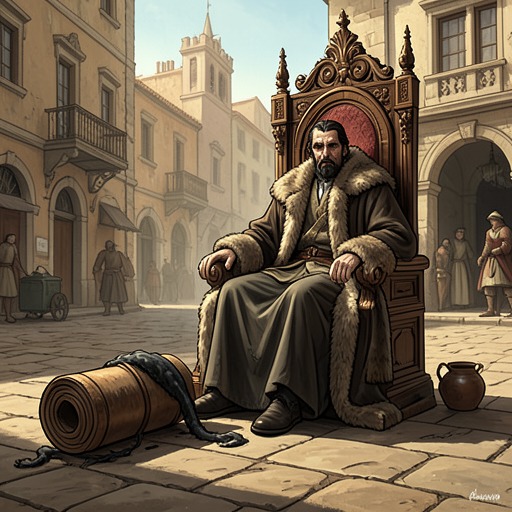
Ferdinand II of Aragon
The PrinceFerdinand II of Aragon appears as one of the book’s clearest examples of a ruler who made reputation an instrument of government. Described as having risen from one of the weakest positions to become, in fame and glory, the foremost King in Christendom, he built authority through a sequence of wars and political enterprises. His significance lies not in a single conquest but in the way each undertaking supplied resources, discipline, prestige, and momentum for the next.
Identity and Political Significance
Ferdinand II of Aragon is treated as a “new Prince” because his standing and power were transformed during his reign rather than simply inherited as an already secure political order. The account measures him through achievement: his fame, military activity, command over his subjects, and ability to turn ambitious designs into a sustained method of rule. He is therefore less a portrait of private character than a case study in how a ruler acquires political weight by acting decisively and continually.
His example is placed alongside other rulers whose fortunes depended on the conditions under which they acquired power. The book distinguishes between rulers who rise by their own ability and those lifted by another’s fortune, as in the contrast between Francesco Sforza and Cesare Borgia. Ferdinand belongs to the broader argument that a ruler must establish foundations through effective action, not rely passively on inheritance, opportunity, or external support. His authority grows because his enterprises repeatedly demonstrate capacity rather than merely claiming it.
The War for Granada
At the beginning of his reign, Ferdinand made war on Granada, and the campaign became the foundation of his power. He conducted the war leisurely at first, a pace that served a political purpose beyond the battlefield. By keeping the Barons of Castile absorbed in the conflict, he prevented them from turning their attention toward domestic changes or opposition. The war thus occupied a potentially troublesome elite while allowing Ferdinand to increase his reputation and authority almost imperceptibly.
The campaign also strengthened the material and institutional basis of his rule. Ferdinand maintained his armies with money drawn from the Church and from his subjects. During the prolonged contest, he established the foundations of the military discipline for which he later became famous. War was consequently not only an external undertaking: it became a means of concentrating attention, organizing resources, disciplining forces, and making the monarch’s authority visible throughout his realm.
The Granada campaign also shows how Ferdinand joined political calculation to religious justification. He used the religious character of the enterprise to cloak further undertakings, presenting expansion under a sacred pretext. The account calls his expulsion and clearing of the Moors from his Kingdom “pious cruelty,” treating the action as both extraordinary and politically effective. In this formulation, religious purpose supplied legitimacy while coercion removed an internal population regarded as an obstacle to the consolidation of the Kingdom.
Expansion Through Successive Enterprises
After the war in Granada, Ferdinand used the same religious pretext to make war on Africa, invade Italy, and finally attack France. These actions are presented as a connected sequence rather than isolated episodes. Each new enterprise emerged from the momentum of the preceding one, and the succession kept his subjects focused on the results of royal action instead of giving them a settled interval in which to form resistance.
The method depended on suspense and admiration. Ferdinand kept the minds of his subjects occupied with vast designs whose outcomes followed one another in close succession. Because attention remained fixed on what the King was planning and accomplishing, opposition lacked time and opportunity to consolidate. His reputation was therefore produced not only by victory but by the continuous rhythm of ambitious action: war created fame, fame enlarged authority, and authority enabled further war.
The account’s brief reference to Ferdinand’s invasion of Italy places him within the wider struggle over the Italian states. The same book criticizes France for enabling the growth of the Church and Spain in Italy and for thereby contributing to France’s own ruin. Ferdinand’s expansion is thus part of a broader pattern in which one power’s actions create the conditions for another’s rise. His political success illustrates the danger that a ruler or state may inadvertently strengthen a rival whose subsequent power becomes impossible to control.
Reputation, Resources, and Rule
Ferdinand’s reputation rested on the visible scale of his enterprises, but the campaigns also supplied practical means of government. The war in Granada drew on Church and subject revenues, while its duration allowed the gradual construction of military discipline. His example therefore links symbolic authority to administrative and military capacity: fame was not merely ornament, because it helped secure cooperation, finance armies, and keep powerful subjects politically engaged.
The book presents this process as a form of cumulative state-building. Ferdinand did not wait for danger to force him into action. He selected enterprises large enough to occupy his Barons and subjects, gave them a religious frame that enhanced their public legitimacy, and used the resulting campaigns to develop the forces required for later undertakings. The sequence turned political action into a reinforcing cycle in which military organization, fiscal extraction, religious authority, and reputation supported one another.
Ferdinand’s career also clarifies the book’s broader distinction between external conquest and internal control. A ruler may possess territory yet remain insecure if his subjects, nobles, or military forces have leisure and incentive to challenge him. Ferdinand’s continuous activity addressed that danger by directing elite ambition outward and by making royal authority the source of successive achievements. His rule appears strongest when the kingdom is not politically idle, because idleness would allow rival interests to become visible and organized.
Narrative Role and Evaluation
Ferdinand II of Aragon functions as an exemplary case in the chapter on how a Prince should acquire reputation. The governing principle is that nothing makes a Prince so well thought of as undertaking great enterprises and providing striking proofs of capacity. Ferdinand embodies that principle through the progression from Granada to Africa, Italy, and France. His importance in the narrative comes from the clarity with which his actions demonstrate the conversion of public achievement into durable political standing.
Yet the portrayal is not a simple celebration of conquest. The religious cloak surrounding his wars, the fiscal burden placed on the Church and subjects, and the description of the expulsion of the Moors as “pious cruelty” expose the coercive structure beneath the spectacle of greatness. Ferdinand’s reputation depends on the ability to make harsh measures appear part of a larger sacred and political design. The narrative therefore presents him as effective because he joins force to appearance, ambition to organization, and violence to a legitimating cause.
His final significance lies in the architecture of succession between enterprises. Ferdinand is powerful in the account because he does not allow one achievement to stand alone. Granada establishes authority; prolonged warfare develops discipline; religious justification opens the way to further campaigns; and the succession of undertakings keeps the political community in suspense. The result is a portrait of rulership in which reputation is not passively received but manufactured through purposeful, recurring action.